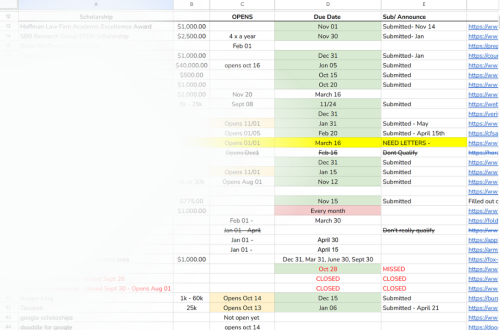
I almost missed a $3,000 scholarship because of a sticky note.
Not because we weren’t trying. Not because my son didn’t qualify. We missed it because I was tracking scholarships on sticky notes, in random browser bookmarks, in a notes app on my phone, and in my head — and somewhere between football practice, work deadlines, and trying to keep up with senior year, that deadline slipped right past us.
If that sounds familiar, you’re not alone. And it’s not your fault.

The Real Reason Families Miss Scholarships
Most parents assume they’re missing scholarships because they don’t know where to find them, or because their student doesn’t qualify. But that’s rarely the reason.
The real reason is almost always the same: no system.
Here’s what typically happens:
You find a great scholarship in September. You bookmark it, maybe screenshot it, tell yourself you’ll come back to it. October gets busy — homecoming, midterms, college application deadlines. November hits and you’re deep in FAFSA paperwork. Then one day in December you’re cleaning up your phone and you find that screenshot. The deadline was November 30th.
That’s not a parenting failure. That’s an organization problem. And organization problems have solutions.
The 5 Most Common Scholarship Tracking Mistakes
1. Relying on memory
Senior year is one of the busiest seasons of a family’s life. Between athletics, academics, college applications, FAFSA, and graduation planning — there is simply too much happening to keep scholarship deadlines in your head. Memory is not a system.
2. Scattered bookmarks and screenshots
Bookmarks in Chrome, screenshots in your camera roll, emails forwarded to yourself — these feel like organization but they’re actually just clutter in different places. When deadline season hits, you can’t find anything quickly enough to act on it.
3. Starting too late
Many families don’t start actively tracking scholarships until second semester of senior year. By then, dozens of early deadlines have already passed — including many local scholarships that have less competition and higher award rates.
4. Not tracking the full picture
A scholarship isn’t just a deadline. It’s a set of requirements, an essay prompt, recommendation letters, transcripts, financial documents, and sometimes an interview. If you’re only tracking the deadline and not the full checklist of what’s needed, you’ll get to the deadline unprepared.
5. No weekly routine
Scholarships don’t wait for you to have a free weekend. The families who win the most scholarships treat it like a part-time job during senior year — a consistent weekly routine of checking deadlines, working on applications, and tracking progress.
What Organized Scholarship Families Do Differently
After going through this process with my own son — and nearly missing several scholarships in the process — I started paying attention to what actually works.
The families who consistently find and win scholarships aren’t smarter or less busy than you. They just have a system that does the remembering for them.
Here’s what that looks like in practice:
They use one central place. Not bookmarks AND a notes app AND sticky notes. One place where every scholarship they find gets entered immediately with the deadline, amount, requirements, and status.
They can see everything at a glance. They know at any moment exactly how many scholarships are in progress, what’s due in the next two weeks, and what still needs to be started. There’s no mental overhead — the system tells them what to do next.
They reuse their work. Every scholarship essay their student writes gets saved. Every bio, every activity list, every financial summary. When the next scholarship application opens, they’re adapting existing work — not starting from scratch.
They track the full process. Deadlines, yes — but also recommendation letter requests (did that teacher actually submit it?), required documents (is the transcript uploaded?), and follow-up tasks (did we send a thank-you note after the interview?).
They check in weekly. Not daily, not sporadically. Once a week for about 10 minutes to update statuses, note upcoming deadlines, and plan what to work on that week.
The System I Built After Almost Missing Everything
After our close call with that $3,000 scholarship, I knew we needed something better. I tried spreadsheet templates from Pinterest. I tried planners. I tried apps. Nothing fit quite right for our situation as an athlete family juggling recruiting alongside scholarships.
So I built my own.
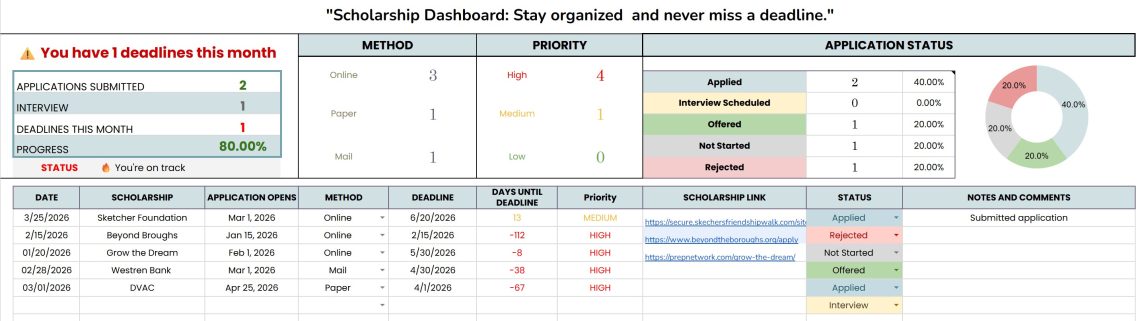
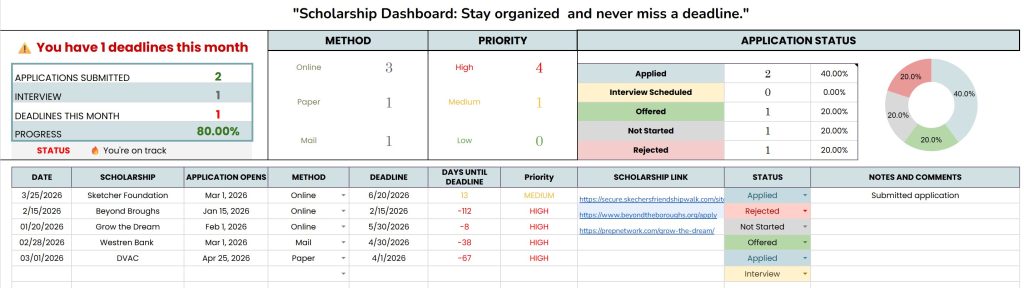
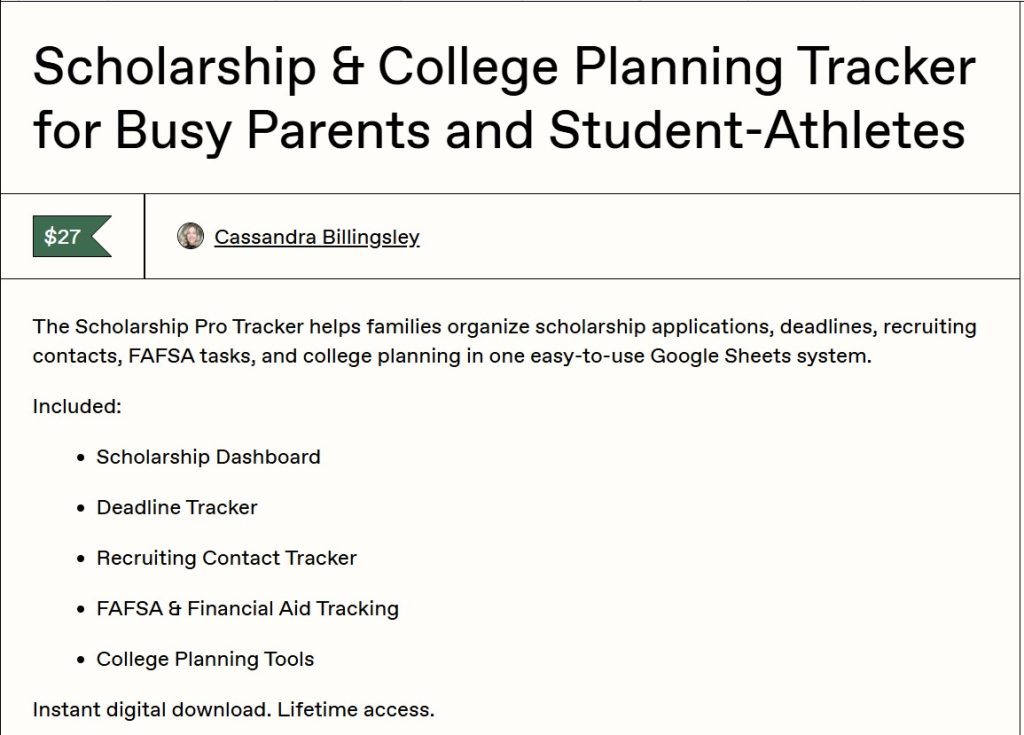
The Scholarship Pro System is a Google Sheets tracker designed specifically for overwhelmed families. It has everything in one place:
- A scholarship dashboard that shows your full list, priorities, deadlines, and application status at a glance
- A calendar timeline so you can see exactly what’s coming up and plan ahead
- A scholarship accounts tracker to keep all your login credentials organized in one place
- An essay bank to save and reuse scholarship essays instead of starting from scratch every time
- A recommendation letter tracker so nothing slips through the cracks
- A senior year checklist covering FAFSA, graduation, college applications, and more
- An athlete recruiting tracker (coming soon as a bonus) for families navigating athletics and scholarships simultaneously
It works in Google Sheets — which is free and accessible on any device. And once you make your copy, it’s fully yours to customize for your student.
Get the Scholarship Pro System for $27 →
When Should You Start?
The honest answer? Yesterday.
But the practical answer is: right now, wherever you are in the process.
If your student is a junior, you have a full year to get organized before deadlines really pile up. That’s the ideal time to start.
If your student is a senior, you still have time. Thousands of scholarships have deadlines in the spring semester. Getting organized today means you stop missing the ones still available and make the most of what’s left.
If your student has already graduated — bookmark this for the next one, and share it with every parent you know who has a high schooler coming up.
A Note From One Mom to Another
I’m not a financial advisor or a college counselor. I’m a working mom who navigated senior year, athletic recruiting, scholarship applications, dual enrollment, and graduation planning all at the same time — without a roadmap.
I made mistakes. I missed things I shouldn’t have missed. And I built a system so you don’t have to make the same ones.
You’re already doing so much. Let a system do the remembering for you. Check out
Not ready to dive in yet? Start here for free.
If you’re still in the research phase — totally okay. I put together a free Scholarship Checklist for Overwhelmed Moms that walks you step by step through exactly where to start, what mistakes to avoid, and how to build a simple system even if you only have 10 minutes a day.
No overwhelm. No fluff. Just a clear starting point.
👉 Download the Free Scholarship Checklist
Already know you need a full system? The Scholarship Pro System has everything in one place — grab it here for $27.
Frequently Asked Questions
How many scholarships should we be applying for? There’s no magic number, but most scholarship advisors suggest applying for as many as you qualify for — especially local scholarships, which often have smaller applicant pools and better odds. The goal of a good tracking system is to make applying to more scholarships less overwhelming, not more.
When do most scholarship deadlines fall? Deadlines are spread throughout the year, but there are two big clusters: fall (October–December) for early scholarships, and spring (February–April) for the majority of awards. Starting your tracking system in the summer before senior year means you catch both waves.
What if my student doesn’t have great grades? Many scholarships are not GPA-based. There are scholarships for community service, athletic involvement, specific career interests, heritage, financial need, and many other criteria. A good tracking system helps you find and organize the ones your student actually qualifies for.
Is this system only for scholarships? No — the Scholarship Pro System also covers college applications, FAFSA, recommendation letters, senior year deadlines, and for athlete families, recruiting communication. It’s designed to be a complete senior year organization tool.
Have a student Athlete – but their not getting a full ride – check out “When Athletic Recruiting Isn’t a Full Ride: How Parents Track Scholarships to Cover the Gap”